
Panel Replacements 7 min read
Upgrading From 100 to 200 Amp Service in Arizona: How It Works
Quick answer
Going from 100 to 200 amps replaces the meter-main, service conductors, and grounding, not just the breakers. The job starts with an NEC Article 220 load calculation, then a city permit, a utility disconnect by SRP or APS, inspection, and reconnection. The utility will not restore power until the city approves the work.
Need help with this? See our electrical panel replacement service.
Most people look into a 200 amp service upgrade because something new is coming: an EV, a heat pump, a pool, a casita. Then they search "200 amp service upgrade near me," talk to three electricians, and get three different descriptions of the job. Here is how it actually works in the Valley, from the load calculation to the moment SRP or APS turns the power back on.
A Service Upgrade Is Not the Same as a Panel Swap
A panel swap replaces the breaker panel at the same rating. An old 200 amp panel comes out, a new 200 amp panel goes in, and the size of the utility connection stays the same.
A service upgrade raises the capacity of the whole connection: the main breaker, the meter socket, the conductors coming into the house, and the grounding. From the driveway it can look like we just hung a bigger gray box. It is not the same job.
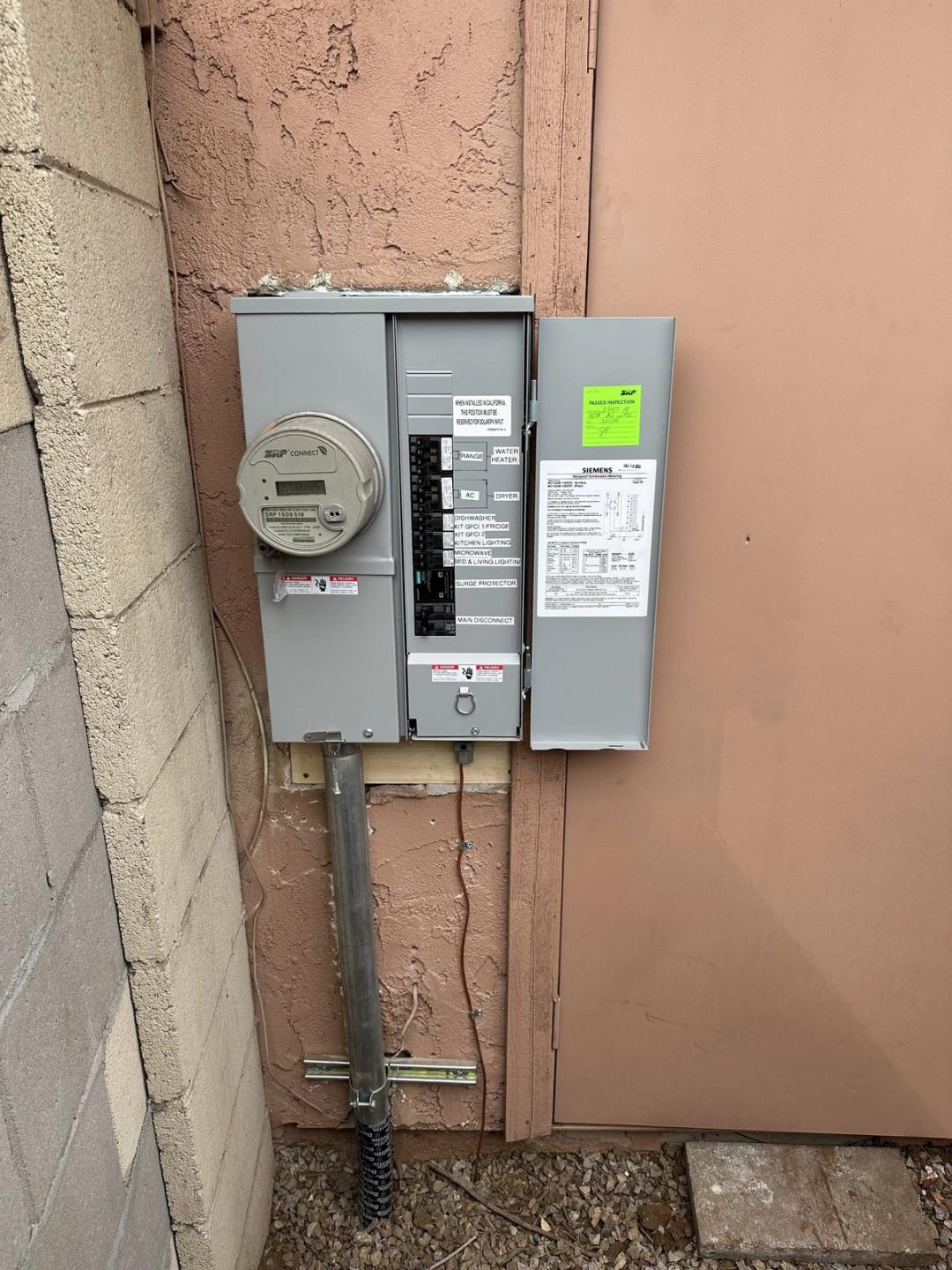
In Arizona the two get tangled together because so many Valley homes have a meter-main combo, where the utility meter and the main panel share one enclosure. The utilities push hard toward that equipment. SRP's service specifications call for all-in-one equipment on any modification to existing metering, and APS requires an all-in-one meter-main from its pre-approved list on underground upgrades, allowing a separate meter and panel only on overhead service. So in practice, a 100 to 200 amp upgrade here almost always means a new meter-main.
APS also spells out in its service manual that a service entrance being upgraded to a larger main breaker has to be brought up to current code and specification requirements. That is the honest reason a service upgrade is never just a bigger breaker.
Signs You Need One
A 100 amp service is not automatically a problem. A smaller home with a gas range, dryer, and water heater can live on it fine. The trouble starts when you add a large load:
- An EV charger. A Level 2 charger is a big load that runs for hours, and on a 100 amp service it often does not fit next to the air conditioner. Our EV charger installation page covers the charger side.
- A larger AC or a heat pump. Upsizing the system, or trading gas heat for a heat pump with electric backup heat, adds load on exactly the days the house is already working hardest.
- A pool, spa, or pool heat pump.
- A casita, ADU, or garage conversion. We walked through that in our post on casita and ADU electrical.
- A kitchen remodel, especially going from gas to induction or adding a wall oven.
- A full panel with nowhere to land the next circuit.
None of those settles the question by itself, though. A load calculation does.
Step 1: The Load Calculation
Article 220 of the National Electrical Code is how an electrician works out what a house actually needs. It is not adding up every breaker in the panel. For a single home, the optional method in 220.82 counts the first 10 kVA of general load at 100 percent and the rest at 40 percent, then adds the larger of the heating or cooling load. A related section, 220.83, is written for checking whether an existing house can take on new load.
There is another route worth asking about. Section 220.87 allows the existing load to be based on a full year of actual maximum demand data, taken at 125 percent, with the new load added on top. In the Valley, a year of data includes July, which is exactly the month you want it to include.
Sometimes the math says your existing service can carry what you are adding, and a good electrician tells you so instead of selling an upgrade. When it says no, the same calculation shows the city why 200 amps is the right size. Chandler's homeowner permit manual, for example, asks for a panel schedule and notes that load calculations may also be required.
Step 2: The City Permit
A service upgrade is permitted work, and each city runs its own process: Mesa through Development Services and its DIMES system, Gilbert through its OneStopShop portal, Phoenix through the Planning and Development Department, and so on. Phoenix lists service upgrades up to 200 amps among the residential permits that can be issued over the counter or online, while services of 400 amps or more go to plan review.
The permit matters for more than paperwork. SRP's specifications note that Maricopa County and most cities in its territory have ordinances that keep SRP from energizing the service until the permit is in place and the city or county has approved the installation. APS says the same about work that replaces or relocates its meter. No permit, no power.
Step 3: Coordinating With SRP or APS
Which utility you have depends on your address, not just your city. SRP serves most of Mesa, Gilbert, Chandler, and Tempe, along with Queen Creek, San Tan Valley, Apache Junction, Fountain Hills, and Ahwatukee. APS serves much of central and north Phoenix, most of north Scottsdale, and pockets of Gilbert, Chandler, and Tempe. Downtown Mesa has a third option: the City of Mesa runs its own electric utility in a 5.5 square mile area centered on downtown.
How the work splits:
- The utility owns the meter and its wires up to your equipment. On APS overhead service, its ownership ends at the top of your weatherhead. On underground service, it ends where its conductors land in your meter section. Only utility employees can break the meter seal or pull the meter.
- You own the meter-main and everything past it, including the riser or mast. That is the part the electrician replaces.
- The utility signs off on the change. SRP treats a change in ampacity as a modification that its Distribution Design group and the city both have to approve, and it reconnects power once both have. APS asks to be contacted before service is changed and requires three days' notice to de-energize a service outside an emergency.
Your electrician should make those calls and line up the disconnect, inspection, and reconnect. On the SRP side, projects that need new, upgraded, or relocated service go through SRP's Project Plan Portal (opens in a new tab). On the APS side, the upgrade rules are in section 200 of APS's Electric Service Requirements Manual (opens in a new tab).
Step 4: Inspection and Reconnect
The sequence is utility disconnect, installation, city inspection, utility reconnect. The utility restores power only after the city approves the work, not on the electrician's word.
Overhead vs. Underground Service
Overhead service comes from a pole to a mast or riser on your house. The utility's drop attaches at the house, and the mast and weatherhead are yours. When the riser also holds up the service drop, SRP requires it to be continuous rigid or intermediate steel conduit, so an old mast often gets replaced along with the meter-main. APS does not allow an overhead riser to be enclosed in a wall, which rules out a flush-mounted panel on overhead service.
Underground service comes up out of the ground into the bottom of the meter-main. Many of these units are semi-flush, set partly into the stucco or block. Replacing one means cutting and patching the wall, and that should be written into the quote, not discovered on the day.
Converting overhead to underground is a much bigger project. SRP's specifications make the customer responsible for it, and the new trench and conduit must be inspected before backfill.
How Long It Takes
Neither utility publishes a fixed timeline for a residential upgrade, so be skeptical of a firm date given before the permit and utility review are done. What moves the schedule:
- Whether the permit is issued over the counter or goes to plan review
- How much the utility has to do on its side, and when its crews can get there
- APS's three-day notice to de-energize the service
- Mast, riser, or underground conduit work, and especially an overhead to underground conversion
- When the city inspection can be scheduled
The outage itself is usually the short part. On a straightforward replacement, the power is typically off for part of a single day.
What to Ask For in a Quote
When you compare quotes for a 200 amp service upgrade, each one should cover:
- A written load calculation, not just "you need 200 amps"
- Who pulls the permit, and whether the final inspection is included
- Who coordinates with SRP or APS and schedules the disconnect and reconnect
- The exact meter-main by brand and model, surface or semi-flush, number of breaker spaces, and confirmation it is on your utility's approved list and meets your city's adopted code (Mesa and Chandler are on the 2023 NEC)
- Grounding and bonding brought up to current code
- Any mast, riser, or conduit work
- Who patches the stucco or block around a recessed unit
- Any new circuits, like an EV charger, listed as separate line items
- The contractor's Arizona ROC license number
For what this work costs, see our electrical panel upgrade cost guide, and our panel and service upgrade page covers how we handle the job.
If you have been searching for 200 amp service upgrades near me anywhere from Mesa to Phoenix, request a free estimate. We will look at your service, run the numbers, and tell you straight whether you need the upgrade.