
Lighting 5 min read
Landscape Lighting Installation: Cost and Ideas for Phoenix Homes
Quick answer
Thinking about landscape lighting for your Phoenix home? Here's what it costs, the best types of lights for Arizona, and what to expect from a pro install.
Need help with this? See our landscape and outdoor lighting service.
If you've ever driven through neighborhoods like DC Ranch, Eastmark, or Power Ranch at night, you've probably noticed how much of a difference landscape lighting makes. The homes that have it just look better. And the ones without it kind of disappear into the dark.
Landscape lighting improves curb appeal, safety, and property value. What it costs depends on what you want lit and what your property needs.
We install landscape lighting across the Phoenix valley.
How Much Does Landscape Lighting Cost in Arizona?
For a basic landscape lighting package on a typical Phoenix-area home, most homeowners spend between $2,000 and $5,000. That includes the fixtures, wiring, transformer, and professional installation.
On the lower end, around $1,500 to $2,500, you're looking at a front-yard-only setup with pathway lights, a few uplights on trees or the house facade, and maybe a light at the front door.
On the higher end, $5,000 to $10,000 or more, you're talking about a full property design with front and backyard lighting, accent lights on architectural features, pool area lighting, patio lighting, and possibly color-changing or smart-controlled systems.
Here's a rough breakdown of what individual components cost installed:
Pathway lights: $150 to $300 per light installed
Uplights (for trees or house facade): $200 to $400 per light installed
Downlights (mounted in trees): $250 to $500 per light installed
Step or hardscape lights: $150 to $350 per light installed
Transformer: $200 to $500 depending on wattage
Wiring and labor: Varies by property size and complexity
At The Wire Guy Electric, we use flat-rate pricing. We'll walk your property, design the layout with you, and give you a complete quote before any work starts.
Types of Landscape Lighting That Work Best in Arizona
Some types of landscape lighting hold up better in the Arizona climate than others. These are the ones we install most:
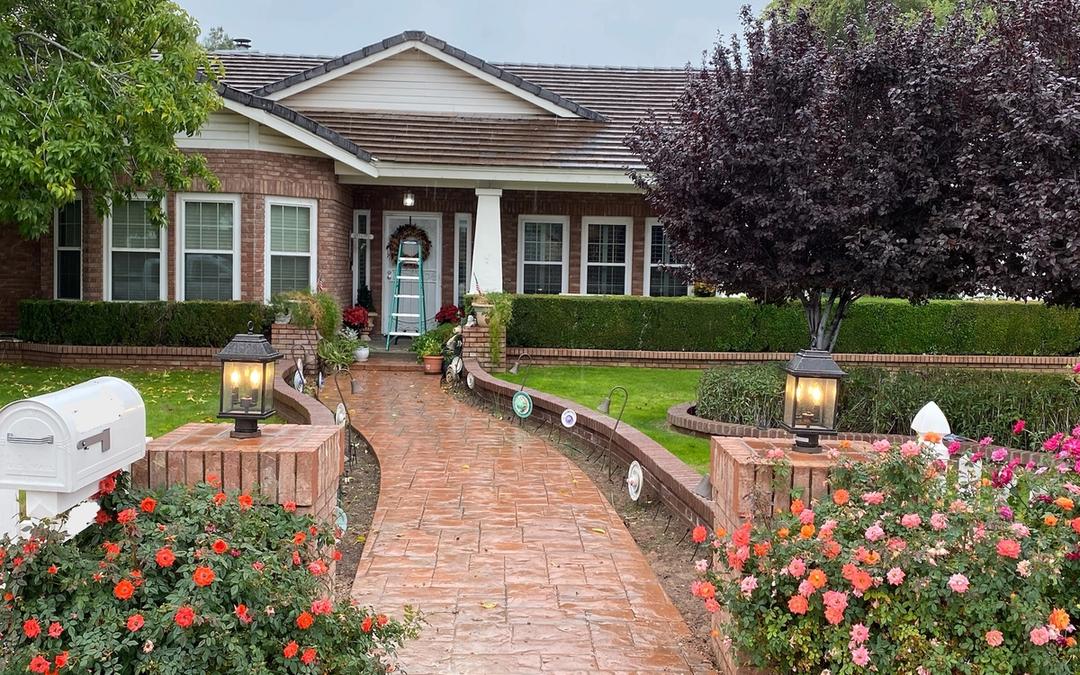
Path lights. These line walkways, driveways, and garden borders. They're functional and add a clean, finished look to your front yard. In Arizona, make sure you choose fixtures rated for extreme heat and UV exposure, or the finish will fade and crack within a couple of years.
Uplights. These are installed at ground level and point upward to highlight trees, saguaros, palm trees, or architectural features on your home. Uplighting a mature palo verde or mesquite tree at night looks incredible and adds depth to your yard.
Downlights (moonlighting). Mounted high in a tree, these point downward and create a natural, moonlit effect on the ground below. It's a softer, more organic look compared to uplighting. Works beautifully with larger shade trees.
Wash lights. These cast a wide, even glow across a surface like a retaining wall, garage door, or the front of your house. Great for making a home's exterior pop at night.
Hardscape and step lights. Built into or mounted on walls, steps, columns, or retaining walls. These are as much about safety as they are about style, especially around pool areas and elevation changes in the yard.
Pool and water feature lights. If you have a pool, spa, or fountain, you can add dedicated underwater or perimeter lights. These require specific waterproof fixtures and proper electrical connections.
LED vs. Halogen: Which Should You Use?
LED. Every time.
Halogen landscape lights were the standard for a long time, but LED has completely taken over for good reason. LED fixtures use 75% less energy, last 10 to 15 times longer, and produce far less heat. That last point matters a lot in Arizona where ground temperatures can hit 150+ degrees in the summer. Halogen fixtures add even more heat to an already hot environment and burn out faster in extreme conditions.
LED landscape lights also come in several color temperatures. For most residential landscapes, we recommend 2700K to 3000K (warm white) which gives that inviting, amber-toned glow you see in high-end neighborhoods. Going cooler than 4000K starts to look harsh and commercial.
Low Voltage vs. Line Voltage
Most residential landscape lighting runs on a low-voltage (12V) system powered by a transformer that plugs into a standard outdoor outlet or is hardwired to your home's electrical system. Low voltage is safer, easier to install, more energy efficient, and works great for the vast majority of residential applications.
Line voltage (120V) landscape lighting is sometimes used for larger properties, commercial applications, or when you need really powerful flood lights for security. Line voltage requires conduit and deeper burial of wiring, and it must be installed by a licensed electrician. It costs more but delivers more power.
For most homes in the Phoenix valley, low-voltage LED is the way to go. The transformer handles the step-down from your home's 120V system to 12V, and the low-voltage wiring can be buried just a few inches below the surface.
What About Solar Landscape Lights?
Solar path lights and accent lights are fine for minimal, decorative use. They're cheap, easy to install, and require no wiring. But they have real limitations:
The brightness is significantly lower than hardwired LED fixtures. Battery life degrades over time, especially in Arizona's extreme heat. They don't work well in shaded areas. And the build quality on most solar fixtures is poor, meaning you'll replace them every year or two.
If you want landscape lighting that is bright and lasts, go with hardwired low-voltage LED. Solar is fine for a few lights along a side path, but not for lighting a whole property.
The Installation Process
Here's what a typical landscape lighting installation looks like with us:
1. Design consultation. We walk your property with you, talk about what areas you want lit, what mood you're going for, and where the key focal points are. We'll recommend fixture types and placement based on your landscaping and architecture.
2. Quote and approval. We give you a flat-rate quote covering everything: fixtures, transformer, wiring, trenching, and labor. No hourly billing, no surprises.
3. Installation. We install the transformer, trench and bury the low-voltage wiring, mount all fixtures, and connect everything. Most residential landscape lighting jobs take 1 to 2 days depending on the scope.
4. Programming and walkthrough. If you have a timer, photocell, or smart control system, we set it up. Then we walk the property with you at dusk to make sure everything looks exactly the way you envisioned it. We'll adjust angles and brightness on the spot.
Landscape Lighting and Home Value
According to multiple real estate studies, quality landscape lighting can increase a home's perceived value by 15% to 20%. It's one of the highest-ROI outdoor improvements you can make, often returning 50% or more of the investment at resale.
Beyond resale, it makes your home safer. A well-lit property deters break-ins, reduces trip hazards on walkways and steps, and makes it easier to navigate your yard at night. In a valley where we spend a lot of time outdoors after dark (because daytime temperatures make it impractical half the year), lighting up your outdoor space means you actually get to use it more.
Get a Landscape Lighting Estimate
If you're thinking about landscape lighting for your Phoenix area home, contact us for a free estimate. We'll walk your property, help you design a lighting plan that fits your style and budget, and give you a straight price before any work starts.
We serve the entire valley including Mesa, Gilbert, Chandler, Scottsdale, Phoenix, Queen Creek, and more. Check out our exterior electrical services or custom lighting page for more on what we offer.
Local help Electrician in Phoenix, AZ